The Lost Art of Ritual
Why modern life strips away meaningful rituals—and why people instinctively build them back through coffee, bourbon, music, and gathering.
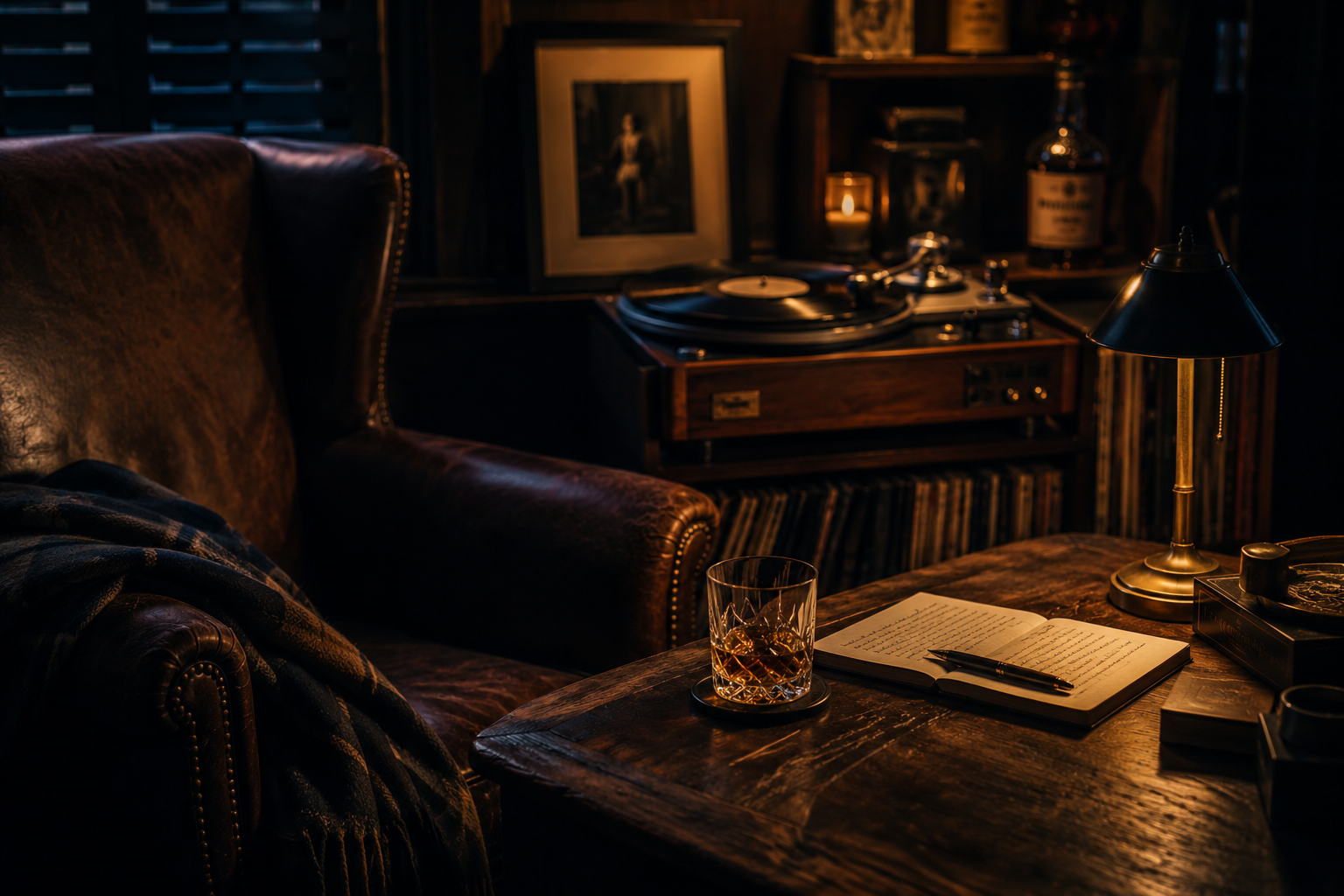
The house is finally quiet.
The dishes have been put away. The children are asleep. The emails have stopped arriving. Somewhere beyond the window, the neighborhood has settled into the stillness that only comes after the business of the day has exhausted itself.
A man lowers himself into a worn leather chair. A record turns slowly on the platter beside him. He pours two ounces of bourbon into a familiar glass and watches the amber liquid catch the light.
Nothing about the moment is productive.
Nothing on his to-do list is being accomplished.
No measurable progress is being made.
Yet if asked, he would likely describe these few minutes as among the most important of his day.
Most people would call this a hobby.
They would be wrong.
What he is practicing is ritual.
That distinction matters because modern life has become remarkably good at helping us accomplish things while becoming surprisingly poor at helping us experience meaning. We live in an age of unprecedented convenience. Groceries arrive at our doors. Entire libraries fit into our pockets. Music follows us from room to room. Conversations travel across continents in seconds. Nearly every inconvenience that frustrated previous generations has become a problem waiting for a technological solution.
By almost every material measure, life has become easier.
Yet many people carry a persistent sense that something essential has gone missing. Not comfort. Not entertainment. Not information. Something deeper.
A sense of rhythm.
A sense of belonging.
A sense that certain moments are set apart from the ordinary flow of life and invested with greater meaning.
In short, a sense of ritual.
For most of human history, ritual was not something people consciously pursued. It was woven into the fabric of everyday life. The seasons created rituals. Religious calendars structured the year. Families gathered around recurring meals. Communities organized festivals, dances, parades, and celebrations. Even ordinary routines carried predictable rhythms that reinforced identity and belonging.
These rituals were rarely remarkable in isolation. Their importance was found in repetition. They reminded people who they were, where they belonged, and what connected them to previous generations. They transformed time from a collection of hours into a collection of meaningful moments.
One of the great misunderstandings of modern life is the belief that ritual was primarily religious. Certainly churches provided rituals, but they were hardly the only source. For much of American history, ritual was embedded throughout civic and community life.
The front porch was a ritual space.
The neighborhood tavern was a ritual space.
The barber shop was a ritual space.
The union hall, church supper, volunteer fire department, Friday night football game, and annual town festival all created recurring opportunities for people to encounter one another in predictable ways. These institutions did more than entertain. They established rhythm. They reinforced relationships. They provided continuity across generations.
When a man visited the same barber his father had once visited, he was participating in a ritual whether he recognized it or not. When families gathered for a monthly church supper, they were strengthening community through repeated action. When neighbors spent summer evenings talking from adjacent front porches, they were building social bonds through simple acts of presence.
Most of these rituals were not carefully designed. They emerged naturally from the rhythms of ordinary life.
That may be why their disappearance has been so difficult to understand.
Few people consciously chose to abandon ritual. Instead, many of the institutions that supported ritual gradually weakened. Families became more geographically dispersed. Civic organizations declined. Work schedules grew increasingly fragmented. Digital entertainment replaced many forms of local gathering. Community life slowly moved from public spaces to private screens.
The loss was subtle enough that many people struggled to identify it.
Yet they felt it nonetheless.
Perhaps that is why some of the most interesting cultural trends of the past several decades make little sense when viewed solely through the lens of convenience.
Consider the rise of specialty coffee. A person can obtain caffeine faster, cheaper, and with far less effort than grinding beans by hand, weighing precise measurements, and carefully pouring heated water over freshly ground coffee. Yet millions willingly embrace the longer process.
Viewed through the lens of efficiency, the behavior seems irrational.
Viewed through the lens of ritual, it makes perfect sense.
The coffee is only part of the experience.
The process is the point.
The same principle helps explain the enduring appeal of vinyl records in an era of limitless streaming. Digital music offers convenience beyond anything previous generations could imagine. Nearly every song ever recorded is available instantly.
Yet many listeners continue to seek out records.
Not because they are easier.
Because they are harder.
Listening to a record demands participation. The album must be selected. The record must be removed from its sleeve. The needle must be lowered. The listener becomes an active participant rather than a passive consumer.
The ritual changes the experience.
The same pattern appears in bourbon culture, cigar lounges, neighborhood barber shops, hunting camps, fishing trips, listening rooms, and backyard gatherings across America. From the outside, these activities appear unrelated. In reality, they are often serving the same human need.
People believe they are protecting hobbies.
What they are actually protecting are rituals.
And rituals do something consumption never can.
They create meaning through repetition.
A bottle of bourbon sitting unopened on a shelf is merely an object. A bourbon shared every Christmas Eve with the same friends becomes a tradition.
Perhaps that is why certain objects continue to endure despite repeated predictions of their decline.
A turntable slows the act of listening.
A fountain pen slows the act of writing.
A Glencairn glass slows the act of drinking.
A cigar slows the act of smoking.
These objects are not valuable merely because of what they contain. They are valuable because of what they require from us. Each introduces a measure of friction into an experience that modern life would otherwise accelerate.
The cigar may be the clearest example.
Unlike many forms of consumption, a cigar demands participation from the very beginning. It must be selected, inspected, cut, toasted, and lit. Once underway, it requires attention. Puff too aggressively and it burns hot. Ignore it for too long and it goes out. The experience rewards patience rather than speed.
The ritual is not something added to the cigar.
The ritual is the cigar.
That may explain why cigars remain culturally relevant despite existing in direct opposition to nearly every modern demand for convenience. A good cigar asks us to slow down, sit still, and pay attention. In doing so, it transforms an ordinary hour into something more deliberate.
When that same cigar is enjoyed at the conclusion of an annual fishing trip, around a campfire with old friends, or during a milestone celebration, another layer is added. The ritual becomes attached to memory. The object becomes attached to story.
The cigar has not changed.
Its meaning has.
Hospitality occupies a special place within this conversation because hospitality is ritual made visible.
A host prepares the room. A drink is offered. Stories are exchanged. A meal is shared. A toast is raised. These acts may appear ordinary, but their repetition creates continuity. Over time they become the moments people remember long after the menu, the bottle, or the occasion itself has been forgotten.
Ask someone to describe a memorable evening from twenty years ago and they rarely begin with what they consumed. They begin with who was there. What was said. How the room felt.
The object fades.
The ritual remains.
Perhaps the deepest irony of modern life is that it did not eliminate ritual.
It privatized it.
Previous generations inherited many rituals from their families, communities, and institutions. Today's rituals are often self-created, highly personal, and frequently practiced alone. The popularity of bourbon clubs, cigar lounges, listening rooms, coffee shops, and other gathering places may represent something deeper than consumer preference.
It may represent a desire to make ritual communal again.
To sit with others.
To share stories.
To participate in something recurring.
To belong.
Perhaps this explains why so many people feel overwhelmed despite possessing more entertainment options than any generation in history.
The problem is not necessarily a lack of leisure.
It may be a lack of meaningful structure.
Entertainment fills time.
Ritual gives time shape.
One distracts us from life.
The other helps us experience it more fully.
The modern world will continue to become faster. Artificial intelligence, automation, and digital convenience will remove even more friction from daily life in the years ahead. Much of that progress should be welcomed. But there is a danger in assuming that every inconvenience is a problem to be solved.
Some forms of friction create meaning.
Some forms of repetition create identity.
Some traditions endure because they satisfy needs that technology cannot.
The challenge is not to reject innovation.
Nor is it to retreat into nostalgia.
It is to intentionally preserve the moments that remind us who we are.
The morning coffee prepared before the household wakes.
The record played from beginning to end.
The standing Friday gathering.
The annual fishing trip.
The shared pour.
The favorite chair.
The recurring toast.
These rituals may appear small, but they are performing some of the oldest work in human history. They create rhythm in a culture of acceleration. They create belonging in an age of fragmentation. They create meaning in a world increasingly organized around efficiency.
Most people do not need another shortcut.
They do not need another notification.
They do not need another way to move faster.
What many of them are searching for is something much older.
A reason to pause.
A reason to gather.
A reason to remember.
A ritual.