The Listening Session
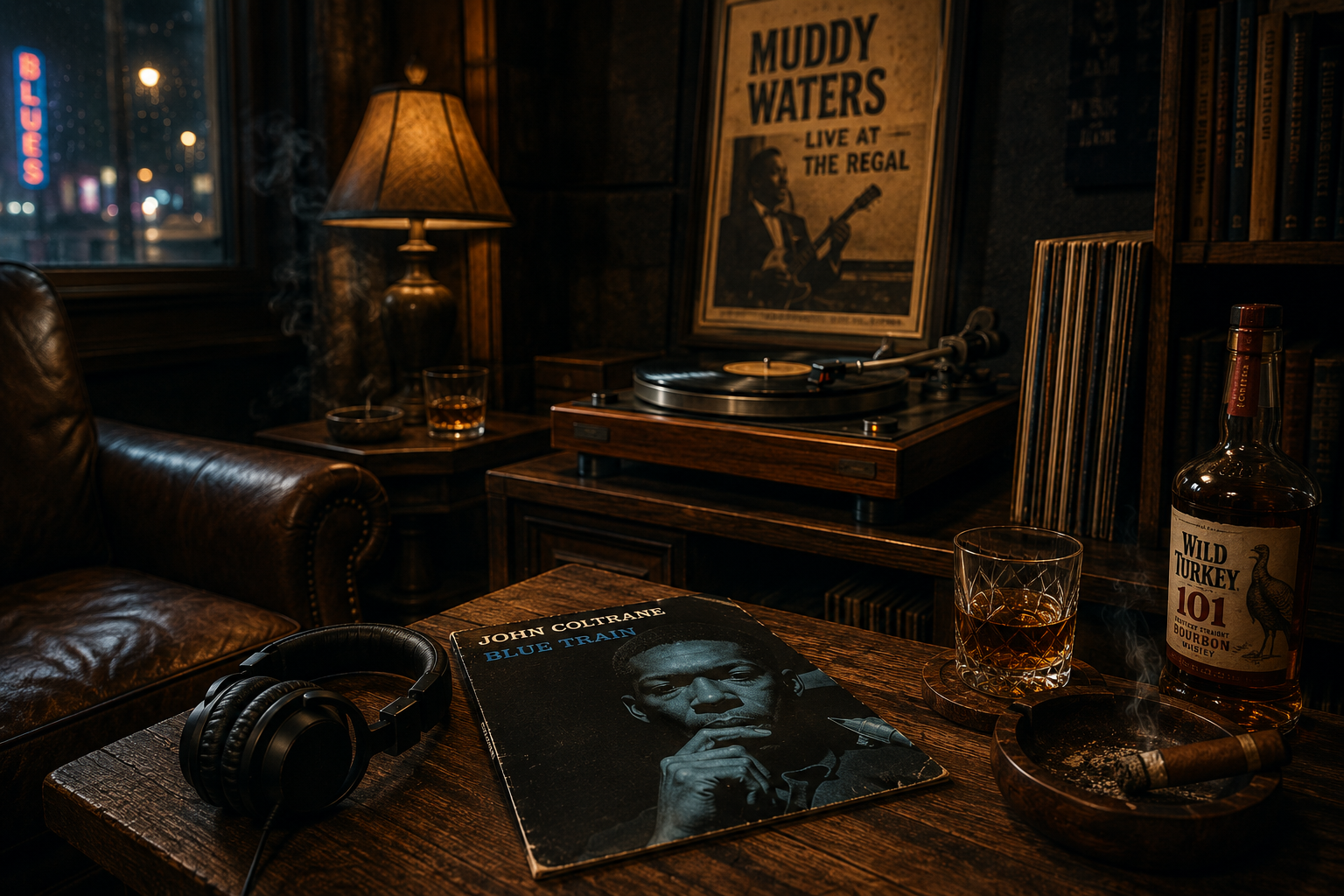
Streaming gave us access to nearly every recording ever made. It may also have taught us to stop listening. The case for restoring something simple: one album, one room, and enough uninterrupted time to hear what the musicians actually made.
There has never been a better time to love music, at least if access is the measure. A listener curious about Chicago blues can move from Muddy Waters to Howlin’ Wolf to Otis Rush in the space of an afternoon, follow Buddy Guy into the next generation, then wander through recommendations until he arrives somewhere he never intended to go. Records that once required a knowledgeable friend, a good radio station, a well-stocked record store, or considerable patience can now be found before the person recommending them has finished explaining why they matter. Nearly a century of recorded music has become less a collection we acquire than a library we carry.
That is an astonishing cultural achievement, and there is no compelling reason to romanticize the inconvenience that preceded it. Scarcity did not make people better listeners simply because music was harder to find. Yet abundance has introduced its own peculiar problem. We now have nearly unlimited access to music at precisely the moment when much of modern life is organized around dividing our attention. Music plays while we drive, cook, exercise, work, answer messages, clean the house, scroll through our phones, or entertain friends. We may spend more time in the presence of music than previous generations did while giving surprisingly little of that time exclusively to music.
The distinction is between hearing and listening, and it is larger than semantics. Hearing allows music to accompany another activity. Listening makes the music the activity. One can be enjoyable without the other, and there is nothing inherently wrong with putting on a playlist while making dinner. The trouble comes when accompaniment becomes our default relationship with recorded music and we begin to forget that some recordings were made with the expectation that the listener would stay long enough to discover what they contain.
The remedy does not require a better stereo, a record collection, or an argument about analog sound. It requires something much harder to purchase: a period of undivided attention.
It requires a listening session.
When the Album Asked Us to Stay
Recorded music has always been shaped by the technology carrying it. The format determines more than sound quality; it establishes boundaries around the experience. The 78-rpm record, the long-playing record, the cassette, the compact disc, the MP3, and the streaming service each altered what could be recorded, how it could be organized, where it could be heard, and how easily a listener could move on to something else.
The arrival of the long-playing record in the late 1940s was especially consequential. Longer playing time made the LP an obvious improvement for classical works and other music poorly suited to the short duration of earlier discs, but musicians, producers, and listeners eventually discovered something more interesting in the format. The album could become an artistic unit of its own. Songs could be sequenced deliberately. Contrasts could be created between one performance and the next. An opening track could establish a mood that a closing track resolved forty minutes later. The artwork, liner notes, photographs, sequencing, and music could together create an experience larger than any individual song.
By the postwar hi-fi era, listening itself had also become a domestic activity worthy of attention. Stereo equipment moved into American living rooms, dens, and dedicated listening spaces, and the record collection became part library, part autobiography, part social object. Friends could gather around music in much the same way they gathered around a card table, a fireplace, or a bottle. Selecting a record was not merely choosing sound for the room. It could be the reason everyone was in the room.
None of this should be mistaken for a golden age. Plenty of records were played inattentively in 1965, just as plenty are heard carefully through streaming services today. Nor was every album conceived as a unified artistic statement. Nostalgia tends to flatten history into a version more orderly than the one people actually lived. What the older formats undeniably possessed, however, was friction. Once a record began, continuing to listen was easier than changing it. Skipping a track required walking across the room and moving the stylus. Choosing something else meant returning the record to its sleeve, finding another one, removing it, placing it on the turntable, and beginning again.
Those small inconveniences created a modest but meaningful bias toward staying.
Then music began to move.
Sony's introduction of the Walkman in 1979 represented one of the most important changes in the social history of listening. Music that had largely belonged to the home, automobile, concert hall, or other shared spaces could now travel privately with the listener. Sony explicitly promoted the device around the idea of enjoying music anywhere, and the concept proved transformative. The Walkman did not diminish serious listening; for many people, headphones made listening more intimate. But it helped establish a relationship with music that now feels entirely ordinary: music could accompany the individual through the rest of life rather than requiring life to pause for music.
The compact disc made navigation easier. Digital files separated songs from physical objects altogether. The MP3 player put hundreds and eventually thousands of tracks into a pocket. Streaming completed the progression by removing even the practical limit of what the listener happened to own.
Each development gave us something valuable. Taken together, however, they gradually changed the question. For much of the history of recorded music, the question was, What should I put on? Increasingly, the question became, What should I hear next?
That is a subtle difference, but it contains much of the modern listening problem.
What Abundance Does to Attention
The scale of contemporary music access is difficult to appreciate because we have become accustomed to it. Industry research has found that listeners spend more than twenty hours a week with music and use numerous methods to access it. In the United States, streaming now overwhelmingly dominates recorded-music revenue. We have not abandoned music. By most measures, we have invited more of it into more parts of our lives than ever before.
What has changed is the cost of leaving.
When almost every recorded alternative is immediately available, abandoning the current one requires essentially nothing. A song begins slowly, and another is waiting. An unfamiliar artist fails to connect in thirty seconds, and thousands of familiar ones remain a tap away. A recommendation appears before the album has ended. The phone that delivers the music also delivers messages, headlines, weather, email, video, photographs, work, games, and nearly every other competitor for our attention.
Streaming did not create impatience, and algorithms did not somehow ruin our capacity to appreciate music. Those are satisfying complaints because they give us something external to blame. The more interesting reality is that technology removed much of the resistance that once stood between an impulse and our ability to act on it. Leaving became effortless. Staying became voluntary.
That distinction matters because some music does not reveal itself immediately.
Anyone who has lived with a record long enough knows this. The song that initially seemed unremarkable becomes indispensable. The track that tempted you toward the skip button turns out to be the hinge on which the album turns. A lyric unnoticed through a dozen casual hearings suddenly changes the meaning of a song you thought you understood. Familiarity does not merely make us comfortable with music; it teaches us how to hear it.
Blues offers a particularly good lesson in this kind of attention because so much of its expressive power resides inside forms that can appear repetitive to an inattentive ear. The twelve-bar structure returns. Phrases repeat. Musical vocabulary passes from one generation to another. A casual listener can hear sameness where an attentive listener hears personality.
The difference may be a guitarist delaying a response to the vocal by a fraction of a beat, a drummer settling just behind the pulse, a bent note held slightly longer than expected, or a singer delivering the same line differently the second time because repetition of the words does not require repetition of the feeling. On a great blues recording, these are not ornamental details surrounding the song. They are where much of the song actually lives.
Albums reveal themselves in similar ways. Sequencing creates meaning that disappears when every track is treated as an independent object. A quiet performance can matter because of the louder one preceding it. A strange detour can reset the ear before the record returns to familiar territory. The final song can acquire weight because we remember where the first one began. When an album is shuffled, sampled, or reduced to its most popular tracks, the individual songs may survive perfectly well while the architecture connecting them disappears.
This is why attentive listening should not be confused with nostalgia for physical media. The object is not sacred. The sequence is not sacred. Even the album itself is not always sacred. What matters is allowing the work enough time to disclose its intentions before we begin imposing ours.
Chosen Constraint
The most interesting thing about a listening session may have very little to do with music.
Modern life is extraordinarily effective at eliminating constraints. We can order dinner without entering a restaurant, watch a film without waiting for its broadcast, read a book without visiting a library, and summon nearly any piece of recorded music without owning it. We can skip introductions, accelerate podcasts, abandon television episodes halfway through, and search for summaries of things we do not have time to experience firsthand. Much of this is useful. Some of it is genuine progress.
Yet there are experiences in which the limitation is not merely an obstacle to the experience. It is part of what gives the experience its shape.
This is one reason ritual persists even when efficiency tells us it should disappear. Ritual places boundaries around time and behavior. Pour whiskey into a glass and, for the moment, the decision about what you are drinking has been made. Light a cigar and its construction establishes a pace; push too aggressively against it and the experience deteriorates. Sit around a dinner table with people who matter and the value of the evening depends partly on an unspoken agreement that, for a while, there is nowhere more important to be.
The listening session belongs to the same family of practices. Choosing one album eliminates thousands of other choices for the next forty or fifty minutes. The limitation can initially feel restrictive because modern technology has trained us to regard optionality as a form of freedom. Yet anyone who has stared at a streaming menu for twenty minutes understands that unlimited choice does not always feel liberating. Sometimes the relief arrives only after the choosing stops.
This suggests a useful way of thinking about ritual in an age of abundance: ritual is often a voluntary reduction of possibility in order to deepen experience.
That is different from nostalgia. It does not require us to pretend the past was better or to surrender the conveniences that make modern life easier. It simply recognizes that attention behaves differently inside boundaries. A person who decides to remain with one record has created a temporary limit, and within that limit subtleties have a chance to become visible—or, more accurately, audible.
The same principle helps explain why physical records have returned so strongly despite streaming's obvious convenience. Vinyl sales in the United States have grown for nearly two decades, surpassing $1 billion in revenue in 2025 even as streaming remained overwhelmingly dominant. Collectibility, artwork, nostalgia, sound preferences, and fandom all contribute to that resurgence, and it would be foolish to reduce a complicated market to one explanation. Still, the record offers something digital abundance does not naturally provide: boundaries. There are only so many songs. They occur in a fixed order. The object has a beginning, an end, and two sides. Once it begins playing, it asks relatively little of the listener except to remain.
Perhaps some of what people are buying when they buy records is not sound at all. Perhaps they are buying a structure for attention.
A Room, a Record, and Enough Time
A listening session need not become another lifestyle performance. There is no required chair, amplifier, turntable, glass, or dress code. An expensive stereo can reproduce music beautifully, but it cannot make its owner listen. A modest pair of speakers in a quiet room can do considerably more if the person sitting between them is paying attention.
The room matters primarily because intention matters. A space changes when everyone in it understands what the next hour is for. The television is dark. The phone is somewhere other than the hand. Conversation either stops or becomes subordinate to the music. A drink may be present, and so may a cigar, but neither needs to become the centerpiece. Their value in this setting is not that they make the room look appropriately sophisticated. At their best, they belong because they share something with the record: they reward patience and resist being hurried.
Then the album begins.
At first, doing nothing else can feel surprisingly unnatural. The hand reaches for the phone almost before the mind has decided why. A thought appears that could be looked up immediately. There is something in the room that could be straightened, something tomorrow that could be planned, some small task that suddenly presents itself as urgent. The impulse is revealing. We have become accustomed not merely to distraction but to filling every available opening with activity.
Stay long enough and the character of the experience changes. A recording that previously existed as a familiar collection of songs begins revealing its internal relationships. You notice the room around the musicians. An amplifier hums. Someone draws breath before entering a verse. Fingers slide across strings. A drummer changes the weight of the performance without noticeably changing the tempo. A solo that once seemed long begins to feel necessary because you finally heard what happened before it.
The recording becomes less like content delivered through a device and more like evidence of an event. At some point, musicians stood together in a room and made a series of decisions—some deliberate, some instinctive, some perhaps accidental. The recording preserved those decisions. Listening carefully is one of the few ways we have of returning to them.
There is no need to make the practice more complicated than that. Choose an album deliberately and begin with the first track. Leave the sequence intact. Resist skipping the song you believe you do not like. Put the phone far enough away that retrieving it requires a conscious decision. Do not read about the album while listening to it; context can deepen a second encounter, but during the first, allow the recording to make its own case. Most importantly, do not give the hour another job.
This is not really an exercise in slowing down, although it may feel like one. The world outside the room does not become slower because a record is playing. The emails continue arriving, tomorrow remains scheduled, and the obligations waiting beyond the final track remain exactly where they were.
What changes is depth.
Instead of distributing attention across several activities, we allow it to travel farther into one. That is a small distinction with consequences well beyond music. Attention is one of the few resources that cannot be multiplied by technology. We can increase access, storage, speed, and convenience almost indefinitely, but an hour of genuine attention remains an hour. What we choose to give it to determines, in no small part, the texture of our lives.
Streaming has placed an extraordinary inheritance within reach. Robert Johnson's surviving recordings, Muddy Waters at Chess, Miles Davis at Columbia, Aretha Franklin at Atlantic, the Allman Brothers at the Fillmore East, Stevie Ray Vaughan in Austin, and countless musicians whose names never entered the canon can occupy the same library. The appropriate response to that abundance is not resentment. It is gratitude.
But a library is valuable only if we occasionally stop wandering the shelves long enough to read something.
The same is true of music. Access gave us nearly everything. It did not give us attention, because no technology can. That part remains ours to provide.
So the next time an evening offers an unclaimed hour, resist the urge to ask a streaming service what it thinks you should hear. Choose a record yourself. Let the first song lead to the second and the second to whatever the musicians decided should follow it. Stay through the difficult track, the quiet passage, the long solo, and the moment that would disappear beneath conversation if the music were merely filling the room.
When the final note fades, there is no revelation promised. You may decide the album was overrated. You may discover that the song you always skipped was right all along. You may hear something that sends you searching for another musician, another record, another branch of American music you had somehow overlooked.
The outcome is less important than the act itself. For the length of one album, music was not accompanying your life.
You gave it a place in your life and stayed long enough to listen.