Before bourbon became something to collect, blues something to stream, cigars something to rate, and cocktails something to photograph, much of American culture was built around a simpler ritual: sitting somewhere together and staying awhile.
Through the magic of A.I. you can now listen to Burt Reynolds read this article to you. Click play and listen now, or download to listen later!
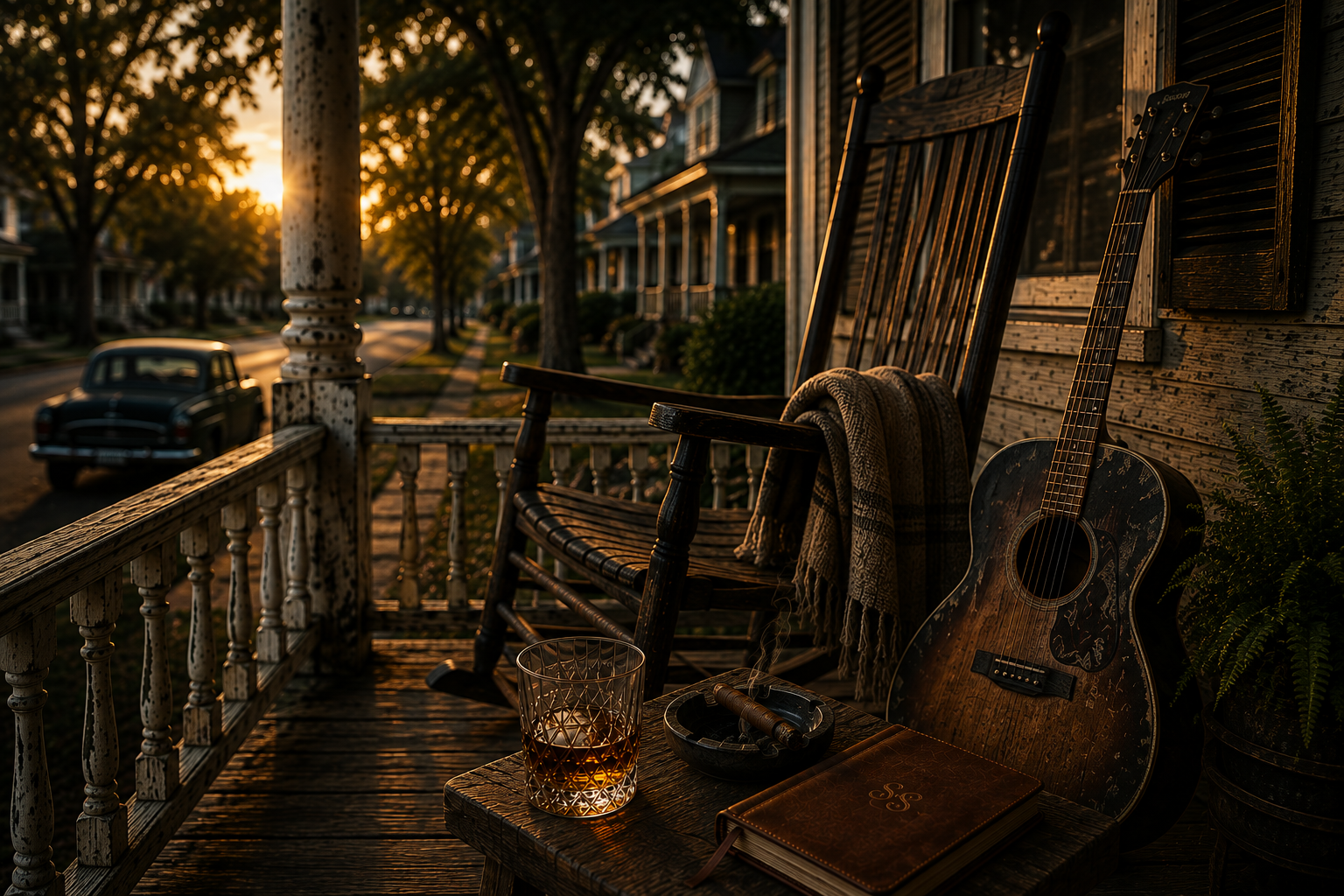
There is an old American scene that requires almost nothing. A porch. A few chairs. Evening settling over the street.
Someone brings out a drink. Someone else arrives without having been formally invited. Conversation wanders. Maybe a radio is playing through an open window. Maybe someone has a guitar. Nobody has assembled for an event, and there is no particular moment when the gathering officially begins. People are simply there.
For generations, the American front porch provided a stage for this kind of life. It was where neighbors talked, families cooled off after dinner, musicians played, stories were repeated, drinks were poured, tobacco was smoked, children listened to adults who had temporarily forgotten they were listening, and the ordinary business of being around other people unfolded without much planning.
The porch deserves our attention not because America needs more rocking chairs or because earlier generations possessed some lost wisdom about neighborliness. The history is considerably messier than the nostalgia. It matters because the porch was particularly good at supporting something that runs through many of America's most enduring cultural traditions: it gave people somewhere to stay awhile.
That may sound inconsequential. It isn't. Bourbon, blues, cocktails and cigars come from different histories and different places. But as American rituals, they share an important characteristic. None reaches its fullest cultural expression when hurried.
Whiskey can be swallowed quickly, certainly. But sharing whiskey is something else. A blues song can occupy three minutes; listening can occupy an evening. A cocktail can be consumed standing at a crowded bar; hospitality begins when somebody makes room. And there are few convincing ways to smoke a good cigar quickly.
The objects differ. The ritual underneath them is remarkably consistent. Someone stays. Someone else joins them. And time begins doing work that cannot be hurried.
A Room Facing the World
The American porch has no single origin. Its architectural ancestry reaches through European, African, Caribbean and other traditions that were adapted across regions and climates in North America. By the nineteenth century, porches had become increasingly common features of American houses, serving practical purposes such as shade and ventilation while also becoming important social spaces.
What made the front porch unusual was its location. It belonged to the house but faced the street.
That distinction created a useful ambiguity. Someone sitting on a porch was home without being entirely withdrawn from public life. A passing neighbor could offer a greeting without making a visit. Someone could stop for a conversation without being formally invited inside. Hospitality could extend beyond the front door without surrendering the privacy behind it.
The porch was not quite a room and not quite public space. It was a threshold.
Americans understood the distinction well enough that in 1880 James A. Garfield conducted much of his presidential campaign from his Ohio home. Thousands traveled to Mentor to hear the Republican nominee address visiting delegations from his front porch. Garfield could participate in national political life while remaining, quite literally, at home.
The episode is memorable because of its scale, but the underlying behavior was thoroughly ordinary. The porch allowed private life to meet public life at the edge. That made it useful for politics. More commonly, it made it useful for everything that happened when people had nowhere more important to be.
What Happens When We Stay
Somewhere along the way, lingering acquired a reputation for being unproductive.
The word itself suggests delay. We linger when we should be leaving. We sit when we could be accomplishing something. An hour spent doing very little requires explanation in a culture that has become exceptionally good at measuring what people produce.
Yet many of the rituals Americans claim to value depend upon exactly that kind of time.
Consider whiskey. The modern bourbon world has developed an extraordinary vocabulary for the liquid itself: age statements, mash bills, barrel entry proofs, warehouse locations, finishes, allocations, secondary values and tasting notes precise enough to identify flavors the distiller may be surprised to learn were inside the barrel.
There is nothing wrong with knowing what is in the glass. But American whiskey culture was never built solely from analyzing whiskey.
A bottle placed between people has another purpose. It slows the evening. It marks an arrival or departure. It accompanies stories that improve slightly with repetition. It offers hospitality in a form more substantial than simply asking someone to sit down.
The difference between drinking bourbon and having a bourbon with someone is only a few words. Culturally, it is enormous.
The same distinction exists in cigar culture. A cigar is an inefficient object in the best possible way. It asks for time. Once lit, a substantial cigar may keep someone in a chair for the better part of an hour. The practical world provides relatively few excuses for two adults to sit together that long without requiring some other activity.
The cigar provides one. Conversation does the rest.
This is why porches, patios and cigar lounges feel so natural to the ritual. The smoke is part of the experience, but so is the permission it provides to remain.
Blues carries its own version of this history. Long before the music became a category inside a streaming service, it existed in social environments: homes and porches, churches and streets, house parties, juke joints, clubs and bars. The history varies enormously by region, generation and performer, and the romantic image of the solitary bluesman playing on a Southern porch can flatten a much richer musical tradition if we allow it to stand for the whole.
But the porch does belong to that history. Musicians learned from people within hearing distance. Songs traveled person to person. Music accompanied gatherings rather than requiring a ticketed performance to justify itself. The distinction between musician and audience could be considerably less rigid than the stage eventually made it.
That history helps explain why listening to blues in a room with other people remains different from merely having access to the recording. The music is only part of what is being shared.
The Porch Was Never Paradise
We should resist making too much of the scene. The American porch did not produce an America in which everybody knew their neighbors and communities lived harmoniously. Such an America never existed.
The porch occupied the same complicated society as everything around it. Race determined where Americans could live and gather. Class shaped the houses they occupied. Gender influenced who was expected to perform domestic labor and hospitality. A porch could welcome someone, but it could also serve as a place from which strangers were watched and social boundaries enforced.
Even the romantic image of porch life varies enormously depending on whose porch we imagine.
The important claim is therefore narrower. Architecture does not create virtue, but architecture can make certain behaviors easier. The traditional front porch made it unusually easy to occupy private property while remaining available to the world beyond it.
And that availability produced something more important than constant conversation. It produced familiarity.
The person walking past every evening eventually becomes the person whose name you know. The neighbor three houses down becomes someone you recognize at the grocery store. A greeting occasionally becomes a conversation. Nothing dramatic has happened, but anonymity has weakened.
Community often begins well before friendship. It begins when strangers stop being strangers. The porch helped that happen almost accidentally.
When American Life Moved Inside
It is tempting to blame the porch's decline on air conditioning.
Mechanical cooling certainly mattered. Before it became widespread, the porch offered something the interior often could not: relief from the heat. When American homes became comfortable through summer, one practical reason for moving outside diminished.
But no single invention killed porch culture. Americans accumulated reasons to move elsewhere.
Automobiles changed how we traveled through neighborhoods. Radio and television brought entertainment indoors. Backyard patios and decks offered outdoor life with greater privacy. Suburban development changed the relationship among houses, streets and commercial life. Attached garages allowed residents to move from house to automobile and back again with remarkably little exposure to the neighborhood.
Eventually, digital technology gave us something previous generations could barely have imagined: virtually unlimited entertainment without leaving the chair.
These were not bad trades. Air conditioning made homes safer and more comfortable. Cars expanded opportunity. Backyards gave families privacy. Television and the internet brought extraordinary information and culture into ordinary homes.
The interesting question isn't why Americans accepted these things. Of course we did. It is what disappeared as the conveniences accumulated.
The front of the American house became less necessary to daily life, and gradually, much of American social life separated into two categories. Private time happened at home. Social time became something we arranged: dinner reservations, concert tickets, parties, meetings, events, text messages asking whether Saturday at seven works.
The territory between solitude and organized social activity became thinner. The porch had occupied exactly that territory.
Community Had Architecture
This is where the old porch begins to look surprisingly contemporary.
Modern discussions about isolation usually concentrate on behavior: put down the phone, get out of the house, meet people, join something. It is reasonable advice, but it assumes community is primarily something individuals must decide to manufacture.
The porch suggests that environment matters too. There was no need to decide to “socialize” when sitting outside after dinner. Someone simply appeared. A greeting happened. Perhaps conversation followed. The architecture carried part of the burden.
Three things made that possible: people were present, interaction was permitted without being required, and encounters were repeated often enough for recognition to develop. Presence, permission and repetition.
Those conditions did not disappear with the porch. They migrated. And this is where the porch's history begins to intersect directly with the places that sustain the culture Stave & Slide cares about.
The Porch Moved Downtown
Walk into a good neighborhood bar early enough and watch what happens—not the fashionable place with a line outside, not the nightclub whose purpose is spectacle, but a real neighborhood bar.
Someone arrives alone and takes a familiar stool. The bartender acknowledges him before reaching for the bottle. Another customer joins the conversation without introduction. Someone else remains mostly quiet. Nobody finds this arrangement strange.
The American bar performs a function remarkably similar to the porch. It is public enough to encounter strangers and private enough to develop familiarity. The cocktail matters. So does the room around it.
At its best, bartending has always understood this. Hospitality is not simply the competent manufacture of drinks. It is the creation of a place in which people understand, almost instinctively, how to belong.
The same phenomenon appears in cigar lounges. Regulars occupy familiar chairs. Conversations begin halfway through subjects discussed the previous week. Newcomers are gradually absorbed into the room. The cigar creates time, but repetition creates the culture.
Blues clubs do it too. There is a particular difference between attending a concert and belonging to a music room. In the latter, audiences begin recognizing one another. The bartender knows who comes for which musicians. Performers know the people near the stage. A venue gradually develops memory.
These places are not interchangeable, but they inherit something the porch understood: they make lingering legitimate. And they create a particular American character who may be more important to community than we realize—the regular.
A regular has crossed the boundary between customer and participant. He may not know everyone's name. She may never see the other patrons anywhere else. But repeated presence has created recognition. Someone notices when the regular enters. Eventually someone notices when the regular doesn't.
That is not friendship exactly. It is something between friendship and anonymity, and American life needs considerably more of that territory than we generally acknowledge.
The Ritual Is Bigger Than the Object
This may be the most important distinction for anyone interested in bourbon, blues, cocktails or cigars.
It is possible to possess every object associated with a culture without actually participating in the culture. You can own hundreds of bottles and never share one. You can know every blues recording and rarely sit through an album without doing something else. You can memorize classic cocktail specifications without understanding hospitality. You can chase cigar ratings without ever learning the peculiar pleasure of spending an unhurried hour talking with somebody you did not know particularly well when the cigar was lit.
Knowledge is not ritual, and consumption is not culture. The difference is often what happens around the object: who poured the whiskey, who played the record, who occupied the next chair, who made the drink, who stayed and who returned.
The old front porch made these conditions almost mundane. You did not need to create an experience. The place itself invited you to inhabit it.
That is why its disappearance deserves more than architectural nostalgia. The porch reminds us that America's cultural rituals have always required somewhere to happen.
Somewhere to Stay Awhile
The answer is not to rebuild nineteenth-century America, nor does every house need a front porch. What matters is preserving the social function the porch represented: places where people can arrive without elaborate plans, remain without justification and encounter the same people often enough for familiarity to form.
Sometimes that place is still a porch. Sometimes it is a neighborhood cocktail bar, a cigar lounge, or the small blues club where the room matters almost as much as the name on the marquee. Sometimes it is a coffee shop, barbershop, stoop, bookstore or table that seems to collect the same people every week.
The architecture changes. The ritual does not.
People arrive, someone makes room, and something is poured, played, lit or shared. Nobody is in much of a hurry. Eventually, almost imperceptibly, a place becomes our place.
That transformation is easy to overlook because it cannot be bought in a bottle, downloaded from a streaming service, shaken into a coupe or stored in a humidor. It has to accumulate.
The front porch was never important simply because Americans sat there. It was important because they returned. And perhaps that is the part of the old porch worth carrying forward.
Bourbon needs somewhere to be shared. Blues needs somewhere to be heard. Cocktails need somewhere hospitality can be practiced. Cigars need somewhere time can be spent without apology.
Culture needs the same thing: somewhere to stay awhile.