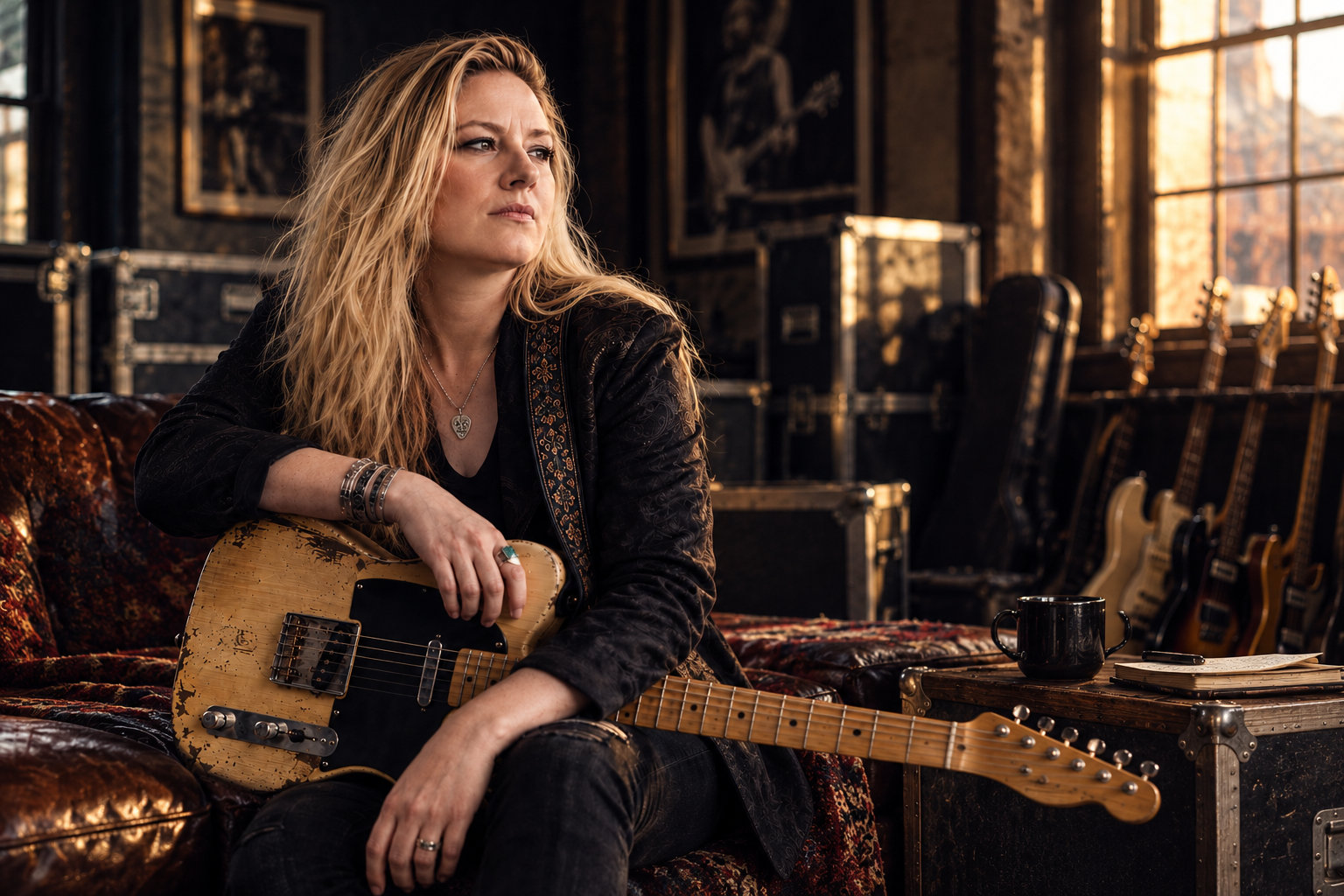
Joanne Shaw Taylor built her reputation as a formidable blues guitarist. The more interesting story is what happened once she no longer needed to prove it.
There is a guitar Joanne Shaw Taylor has trouble playing, although trouble, in this case, has nothing to do with ability. Put a Fender Stratocaster in her hands and Taylor says she is transported back to being thirteen years old, trying to play Stevie Ray Vaughan's “Pride and Joy.” It is an unusually revealing admission from a guitarist whose career began, in many ways, with Vaughan. She was home sick for an extended period when her father put on a video of the Texas guitarist, and what she heard redirected an interest in guitar into something far more consuming. Vaughan led her toward Albert Collins, B.B. King, Freddie King, Jimi Hendrix and the wider vocabulary of electric blues that would shape her early musical life.
Decades later, the Stratocaster remains so closely associated with those formative years that Taylor has never felt entirely herself playing one. She gravitated instead toward Telecasters and, most famously, a vintage Fender Esquire she calls Junior. The distinction may seem like guitar-player minutiae, but it provides a useful way into Taylor's larger story. Every serious craft begins, to some extent, with imitation. We find someone who reveals what is possible and begin by studying the choices that produced it. The difficult part comes later, when competence has been achieved and influence absorbed. At some point, the student has to decide what belongs to the tradition, what belongs to the teacher and, finally, what belongs to her.
Taylor has spent much of her career working through that distinction.
BEFORE THE RECORDS
Taylor grew up near Birmingham in England's West Midlands, in a household where music was part of daily life. Her father played guitar and harmonica, her older brother played guitar, and her mother, a former professional dancer, loved Northern Soul and Motown. Taylor began with classical guitar as a child, but Vaughan changed her understanding of what the instrument could be. The precision of formal lessons gave way to something more physical and expressive, and the blues soon became the center of her musical education.
That education did not remain confined to records. Her father began taking her to The Robin, the storied music club in the Black Country near Birmingham, where touring blues musicians regularly passed through. Taylor has remembered the place without the varnish nostalgia sometimes applies to old music rooms: it was a working club with sticky floors, loud amplifiers and musicians playing within reach of the audience. She eventually gave a demo to promoter Mike Hamblett and began receiving opportunities to open for touring artists. Her recollection of her first song onstage there—Albert Collins' “Don't Lose Your Cool”—is fitting. Before Taylor had a catalog of her own, she was learning how the music behaved in the environment for which it was made.
The blues can become abstract when discussed primarily as history. Its mythology is so substantial that the names, places and instruments sometimes obscure the fundamental fact that this is music passed between people. Someone hears a record, enters a club, watches another player, learns a phrase and eventually changes it. Taylor's relationship with the blues began through precisely that kind of transmission. She did not inherit the culture that created the music, but she approached the tradition seriously enough to learn its language before attempting to add anything to it.
Her professional trajectory changed dramatically while she was still in her teens. Taylor's mother had breast cancer, and Taylor performed at a benefit in Birmingham where a demo found its way, through a friend, to Dave Stewart of Eurythmics. Taylor's own early account of the episode is less cinematic than the frequently repeated claim that Stewart simply walked into a room, heard her play and “discovered” her. He received the demo, called her the next day, and soon had the young guitarist in London. Taylor has recalled sitting in Stewart's kitchen playing a slow blues while he filmed her because he wanted to show the footage to Quincy Jones.
Stewart subsequently brought Taylor into his D.U.P. project, giving her exposure to professional musicians and touring while she was still a teenager. Yet the most consequential part of the relationship may have been Stewart's insistence that Taylor think beyond the instrument that had gotten his attention. She has recalled him imagining her future not simply as a guitar player, but as a songwriter and singer who played guitar. A technically brilliant solo meant relatively little if the audience did not care about the song surrounding it.
The lesson would prove unusually durable. Guitar virtuosity gave Taylor an obvious entrance into the music business, but virtuosity is a precarious foundation for an artistic identity. Skill establishes credibility; it cannot determine what an artist has to say.
AN ENGLISH MUSICIAN IN AMERICA
Taylor's debut, White Sugar, arrived in 2009, produced by Jim Gaines, whose credits included work with Vaughan and Collins. The album introduced the combination that would define Taylor's early career: muscular electric guitar, a strikingly weathered singing voice and an emerging songwriter whose compositions were already more than scaffolding for solos. Diamonds in the Dirt followed in 2010, and the two records established her internationally. British Blues Awards recognized her singing, while “Same as It Never Was” brought recognition for songwriting.
The public shorthand around Taylor nevertheless emphasized the guitar, as it almost inevitably would. She was young, female and exceptionally accomplished in a corner of popular music still crowded with male guitar heroes. The obvious story was that a British blues prodigy had arrived. The quieter and ultimately more consequential story was that Taylor was already developing the skills that would eventually make the prodigy label inadequate.
America became part of that education. As touring opportunities grew, Taylor established herself in the United States and eventually settled in Detroit, where she would live for roughly fourteen years before relocating to Nashville. Practicality played a role; the size of the United States made it possible to build a touring career across a vast network of cities and venues. Taylor has also described a more personal motivation. Most of the musicians who had shaped her were American, and she wanted to experience the country behind the records.
Detroit was an interesting place for that education to continue. It was not the Mississippi Delta or Chicago's South Side, the places most readily summoned when blues history is discussed, but a city with its own formidable musical identity. Motown, soul and garage rock existed alongside the industrial culture that made Detroit synonymous with making things. Taylor's long residence there placed an English guitarist shaped by American records inside another distinctly American musical environment, adding another layer to an identity already becoming difficult to reduce to geography or genre.
Taylor has jokingly described herself as something of an “English American,” missing English pubs while living in the States and American bars while back in Britain. Beneath the joke is a useful description of her artistic position. She has spent much of her career between places and categories: British but deeply shaped by American music, rooted in blues but increasingly unwilling to let the category dictate the limits of her work. Rather than resolving that tension, Taylor eventually learned to use it.
THE DANGER OF GETTING GOOD
By the time Almost Always Never appeared in 2012, Taylor was testing the expectations established by her first records. That same year brought one of the more visible performances of her career when she joined Annie Lennox at the Diamond Jubilee Concert for Queen Elizabeth II at Buckingham Palace. Yet a quieter experiment from roughly the same period says considerably more about her development as a musician.
Taylor had begun to feel stale on the guitar. Instead of refining the equipment and technique she already knew, she deliberately made herself uncomfortable. Long associated with Fender-style instruments, she spent about a year playing a Gibson Les Paul and even changed the picks she used, forcing her hands to negotiate an unfamiliar physical relationship with the instrument. The Les Paul did not permanently replace the Telecaster and Esquire designs that felt natural to her, but permanence was never the point. She wanted to interrupt habit, and when she eventually returned to her familiar instruments, she believed the detour had changed her playing.
There is a larger principle of craftsmanship inside that decision. Competence is built through repetition, but repetition eventually produces habits so efficient that they become difficult to see. What once represented mastery can harden into routine. This is one of the paradoxes of becoming good at something: the practices that make work instinctive can also make it predictable. Taylor's willingness to disrupt her own fluency suggests that she understood relatively early that mastery was not a position to defend but a capacity that occasionally needed to be tested.
The records that followed broadened that lesson. The Dirty Truth arrived in 2014, followed by Wild in 2016, beginning an important working relationship with producer Kevin Shirley. Reckless Heart followed in 2019 and reached the UK Top 20. The guitar remained unmistakably Taylor's, but it was gradually becoming less of the point. Her singing grew more assured, her songwriting more personal, and rock and soul increasingly occupied territory that an earlier version of Taylor might have reserved for blues.
This is one of the dividing lines between impressive musicianship and mature craft. Early in a career, technique is easy to hear because the listener is supposed to notice it. We hear the attack, vibrato and phrasing; we identify influences and compare the player with others who speak the same musical language. With time, technique ideally becomes less conspicuous because it has been absorbed into expression. The question shifts from whether a musician can play to what she chooses to do with the ability she has acquired.
GOING BACK TO THE BLUES
After years of gradually widening the frame, Taylor made one of the most explicitly traditional records of her career. Released in 2021 and produced by Joe Bonamassa and Josh Smith at Ocean Way Nashville, The Blues Album found her interpreting material associated with Albert King, Peter Green, Little Milton, Magic Sam, Aretha Franklin and other figures from the music's history. It debuted at No. 1 on Billboard's Blues Albums chart.
On paper, the album could look like a retreat into safe territory. In the context of Taylor's development, it is more interesting as a return to the source after the source had already done its work. The teenager discovering Vaughan and Collins was gone. In her place was a musician who had spent more than a decade recording, touring and writing. She could revisit the vocabulary that formed her without needing to reproduce the person she had been when she first learned it.
That is one of the quieter rewards of staying with any craft for a long time. Experience changes our relationship with things that once seemed fixed. A record heard after twenty years of listening reveals decisions that were invisible the first time. A familiar whiskey tastes different after someone learns what to look for in the glass. A book revisited later in life can seem to contain passages that somehow escaped notice before. The object may be substantially unchanged; the accumulated experience of the person returning to it is not.
The Blues Album can therefore be heard less as Taylor retreating into tradition than as an experienced artist measuring herself against the music that first taught her how to speak. Blues From the Heart Live followed in 2022, documenting that conversation onstage with guests including Bonamassa, Kenny Wayne Shepherd and Mike Farris. The success of those projects presented Taylor with a comfortable path forward. She had demonstrated that she could inhabit traditional blues convincingly, and an audience had demonstrated that it would reward her for doing so. Her decision not to remain there is where the later catalog becomes particularly revealing.
THE FREEDOM TO WANDER
Nobody's Fool, released later in 2022, allowed pop melody, rock and singer-songwriter instincts considerably more room. Taylor has described the album as a chance to have fun after projects rooted strongly in traditional blues. Rather than treating the success of The Blues Album as an instruction to narrow her work, she appears to have treated it as confirmation that the foundation was secure enough to support exploration.
Heavy Soul made that relationship clearer in 2024. Taylor described the record as an effort to connect the dots between Nobody's Fool and her blues roots, combining contemporary soul-pop with roots music rather than choosing between them. The phrase “connect the dots” is useful because it avoids the familiar language of artists abandoning one genre for another. Taylor has never sounded particularly interested in leaving the blues. What changed was her willingness to regard it as a foundation rather than a boundary.
That distinction matters in a genre carrying an unusually complicated relationship with authenticity. Reverence for blues history is both understandable and necessary. This is music born from Black American experience, and its enormous influence across popular culture has often been accompanied by inadequate attribution and commercial rewards that did not reach many of the people who created it. Yet reverence becomes something different when authenticity is reduced to reproducing the recognizable surfaces of the past. A living tradition cannot survive solely as reenactment; it also requires musicians capable of understanding what they inherited and finding an honest use for it in their own lives.
Taylor's tenth studio album, Black & Gold, arrived in 2025 with that confidence increasingly visible. Blues-rock remained present, but Americana, soul, indie rock and pop influences moved through the record without requiring an apology. The milestone also encouraged a more personal inventory. Taylor had entered her forties and spoke about using the album to address things she did not want to carry indefinitely into the next phase of her life.
“Grayer Shade of Blue” offers one of the clearest examples. Taylor has explained that the song emerged from the abrupt ending of a close friendship that had lasted more than a decade. There was no satisfying final conversation and no explanation that resolved what had happened, so songwriting provided another form of closure. Taylor could not control the ending of the relationship, but she could decide how to understand it and what to do with the emotional residue it left behind.
The episode says more about her evolution than another demonstration of guitar technique could. The instrument that once gave Taylor a way to establish what she could do increasingly serves as a means of examining what has happened to her. The distinction is subtle but fundamental. Young musicians often use technique to establish themselves in the world; mature artists can use the same technique to investigate the world and their place within it.
WHAT COMES NEXT
Taylor's next studio album, The Trouble With Love, is scheduled for release on October 23, 2026, through Journeyman Records, again with Kevin Shirley producing. The announced material continues the broad musical vocabulary of her recent work while examining love in several of its less sentimental forms. Joe Bonamassa and Orianthi appear as guests, and the project arrives at a point when Taylor seems increasingly comfortable allowing individual songs to determine where they belong rather than forcing them into a fixed genre identity.
Among the early material is Taylor's interpretation of Celeste's “This Is Who I Am,” a title that carries an accidental resonance when placed against the arc of her career. It would be too convenient to treat a song Taylor did not write as an autobiographical declaration, but the idea of identity itself matters here because her catalog demonstrates how little artistic identity resembles a fixed point waiting to be discovered. The thirteen-year-old transfixed by Vaughan, the teenager working with Stewart, the young musician building a life in Detroit and the established artist returning to traditional blues before moving outward again are not competing versions of Joanne Shaw Taylor. They are accumulated versions of the same artist.
This may be the more useful way to think about authenticity. We often imagine that finding one's voice means stripping away influences until some untouched, original self is revealed beneath them. Serious craft rarely works that way. A voice is built from what has been absorbed: teachers, places, records, mistakes, habits, experiments and years of repetition. Originality does not require those influences to disappear. It requires them to become sufficiently integrated that they no longer dictate the work.
Taylor's career makes that transformation unusually easy to hear. Vaughan showed a thirteen-year-old in England possibilities she had not known existed in a guitar. Collins and the other blues musicians she pursued afterward expanded the vocabulary. Stewart challenged her to imagine a future in which that vocabulary served songs rather than becoming an end in itself. Years of touring, recording and writing supplied the experience no mentor could provide. By the time Taylor returned deliberately to traditional material on The Blues Album, she no longer needed to establish that she understood where she came from. The more consequential question was where that understanding allowed her to go.
For Taylor, the answer increasingly appears to be wherever the song requires. The blues remains plainly present in the attack of her guitar, the grain of her voice, the records she returns to and the musical instincts she has spent most of her life developing. What has diminished is the need to prove that presence. Soul, rock, Americana or pop can enter without threatening the foundation because the foundation no longer depends on external certification. She has earned the freedom to wander precisely because she knows the road back.
Perhaps that is why the Stratocaster remains such a useful object in Taylor's story. It belongs to the beginning, when influence was immediate enough to be imitated and identity was still being assembled from other people's sounds. She did not need to reject that beginning to move beyond it. Nearly three decades after Stevie Ray Vaughan first showed her what a guitar might be capable of, Joanne Shaw Taylor's most compelling achievement is no longer how convincingly she can speak the musical language that inspired her. It is the authority with which she now decides what she wants to say in it.